Friday, March 30, 2012

Congressional report: Attack on Iran would be a failure !!

http://rt.com/usa/news/iran-report-nuclear-israel-785/

Demonstrators hold placards and shout slogans during a "No War on Iran" protest in Los Angeles, California, on February 4, 2012. (AFP Photo / Frederic J. Brown)

Demonstrators hold placards and shout slogans during a "No War on Iran" protest in Los Angeles, California, on 

A new Congressional report affirms that a potential US or Israeli strike on Iran would be useless since the Islamic Republic could recuperate from it within a six month time frame.

The report sparked by Secretary of Defense Leon Panetta’s remarks claiming he “believes” Israel is “likely” to attack in Iran in either April, May or June, says although US and Israel aren’t certain of the precise location of the nuclear sites, the facilities may be spread out in a way that an attack would result in failure.

Bloomberg described the report stating it is “unclear what the ultimate effect of a strike would be on the likelihood of Iran acquiring nuclear weapons.”

Iran’s alleged “workshops” for producing nuclear centrifuges have had Israeli Prime Minister Benjamin Netanyahu pushing for an airstrike on the program that Iranian officials claim is for peaceful purposes.

What to do about Iran’s nuclear program has created a divide between the US and Israel.

Although the US has hesitated to publicly endorse Israel’s plans to carry-out an attack on the Islamic Republic, Israeli officials have expressed they may have to go it alone, with or without American assistance.

According to the Bloomberg report, last month a former US government official stated to researchers that “Iran’s centrifuge production is widely distributed and the number of workshops has probably multiplied  ‘many times’ since 2005 because of an increase in Iranian contractors and subcontractors working on the program.”

This echoes Netanyahu’s and Israeli Defense Minister Ehud Barak’s concern that sanctions against Iran are futile and an attack should be implemented before it’s too late.

The report states “an attack could have considerable regional and global security, political and economic repercussion, not least for the United States, Israel, and their bilateral relationship.”

In the 52 page document, it states that although President Obama and leaders of Congress have expressed their concerns about a nuclear armed Iran, the American people must have trust in the US intelligence assessments that “Iran has not made a decision to build nuclear weapons.”

The report also acknowledges that the aspects of detailed text are subject to “vigorous debate and remain fully or partially outside public knowledge.”

According to the Congressional Research Service report, Iran has been engaged in nuclear activities for decades and despite extensive examination of the activities by entities such as the International Atomic Energy Agency, there is no “definitive proof” that Iran is attempting to gain nuclear capabilities for warheads. But many argue that Iran is developing their “nuclear capability” just below the verge of nuclear weapons.

In page five of the report it states that “this uncertainty and ambiguity is a major feature of the environment in which international actors decided their policies and actions vis-à-vis Iran.”

Leaders like Netanyahu have taken advantage of these grey areas.

Twice in history, the reports states, “Israel has conducted air strikes aimed at preventing a regional actor from acquiring a nuclear weapons capability.” The report goes on saying Iran and Syria have been victims of the Israeli aggression that the US ally claims was self-defense. But the report says a military move on Iran “would be significantly more complex than previous attacks.”

The CRS report, asks questions like, “what are the factors in Israeli thinking? How does Israel assess the operational requirements of a potential strike? Is an attack more likely to prevent an Iran with nuclear weapons or help bring it about? If Iran retaliated, would it limit the targeted area to Israel?”

The report quotes Netanyahu as saying, “Iran has threatened to annihilate a state. In historical terms, this is an astounding thing. It’s a monumental outrage that goes effectively unchallenged in the court of public opinion…Iranian leaders talk about Israel’s destruction or disappearance while simultaneously creating weapons to ensure its disappearance.”

Although Iran hasn’t attacked a country in decades the fear of a potential assault on Israel continues to put the global community at risk.

According to an article by the Jerusalem Report news outlet, “even if the Iranians don’t use the bomb, [Netanyahu] fears  the very fact that they have it could lead to a mass exodus of Jews from an Israel under nuclear threat, weakening the state and compromising the Zionist dream.”

Bin Laden lived 9 years undetected in Pakistan, fathered 4 children, wife says !!

http://www.foxnews.com/world/2012/03/30/bin-laden-lived-nine-years-undetected...

Former Al Qaeda leader Usama bin Laden entered Pakistan across the Afghan border during the early months of U.S. attacks on Afghanistan, then spent nine years on the run in Pakistan living in several safe houses and fathering four children.


Testimony from bin Laden's youngest wife -- the 29-year-old Yemenite Amal Ahmed Abdulfattah -- before a joint investigation team in Pakistan reveals the Al Qaeda kingpin fled over the border into Pakistan early in 2002, just after the U.S. launched attacks on Tora Bora in eastern Afghanistan.


In the testimony -- first cited Thursday by the Pakistani newspaper Dawn -- Abdulfattah told investigators that she married bin Laden in 2000 because she wanted to marry a mujahid, or holy warrior.


Her account of bin Laden's movements in the nine years leading up to his death in May 2011 raises further questions about what exactly Pakistani authorities knew.

It also threatens to further strain relations between Pakistan and the U.S., just days after U.S. military commanders held high-level meetings with their Pakistani counterparts in an attempt to repair ruptured relations between the two nations.

Abdulfattah said the family separated and fled from its base in Kandahar following the Sept. 11, 2001 terror attacks. She traveled to Karachi, and was eventually reunited with bin Laden in Peshawar in 2002. 

During her testimony, Adbdulfattah said the family's movements and accommodation in Pakistan were organized by "some Pakistani families" and Saad, one of bin Laden's sons.

After the family was reunited in Peshawar they traveled to the Swat Valley, close to the Afghan-Pakistani border, where they lived for eight or nine months.


After that the family moved to Haripur for two years, and later to Abbottabad. They stayed in Abbottabad for almost six years, until U.S. Navy SEALS raided bin Laden's home there in May 2011.


Abdulfattah was shot in the leg during the successful unilateral U.S. operation, but survived. Bin Laden's son Khalil, 20, was among four people killed in the raid.


Abdulfattah gave birth to four children by bin Laden while in Pakistan -- two in a government hospital in Haripur and two further children in Abbottabad.


She is now being held by Pakistani authorities in a house in Islamabad alongside two of bin Laden's other wives.


The widows, and two of bin Laden's daughters -- Maryam, 21, and Sumaya, 20 -- are expected to be charged Monday with breaking Pakistan's immigration laws. The offense carries a possible five-year jail sentence.


An editorial published in the Dawn newspaper Friday said Abdulfattah's testimony should force Pakistan to "take a long, hard look at its record against terrorism."


"For nine years the world's most wanted terrorist survived in the country after fleeing the U.S. attack on Tora Bora [in December, 2001]," it said.


"What is clear is that the judicial commission looking into his presence and the raid in Abbottabad can no longer limit its probe to those topics. In light of this investigation report, the commission now needs to expand its focus to encompass bin Laden's presence in the country since 2002," it added.

Scalia mocks Obamacare provision that doesn't even exist !!

http://www.americablog.com/2012/03/scalia-mocks-obamacare-provision-that.html...

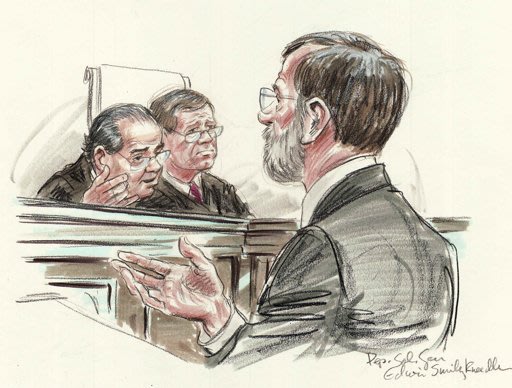
Conservative Justice Antonin Scalia suggested on Wednesday that the Supreme Court could strike the "Cornhusker Kickback" from President Barack Obama's landmark health care overhaul without having to invalidate the whole law. He was right, in a way: The notorious provision isn't in the law.

The "Cornhusker Kickback" was the derogatory nickname of one of several sweetheart deals designed to ensure that the law had enough votes to pass. Amid a public uproar, lawmakers ultimately stripped the measure from the law.

But no one—not Scalia's eight colleagues on the highest court in the land, not Deputy Solicitor General Edwin Kneedler, there to represent Obama, and not the superstar lawyer challenging the law on behalf of 26 states, Paul Clement—challenged his claim.

Scalia's quip came on the third and final day of oral arguments before the court on what has come to be known as "Obamacare," and specifically on whether the justices could rule that the requirement that individuals buy insurance or pay a penalty was unconstitutional but not strike down the rest of the law.

Clement was arguing that the entire law had to go, and Scalia was gently challenging him.

"The consequence of your proposition, 'would Congress have enacted it without this provision,' OK, that's the consequence. That would mean that if we struck down nothing in this legislation but the—what's it called, the 'Cornhusker Kickback'—OK, we find that to violate the constitutional proscription of venality, OK?" Scalia said, to guffaws from the audience.

[Related: Supreme Court divided on whether Obama health care ruling must be all-or-nothing]

Scalia went on: "When we strike that down, it's clear that Congress would not have passed it without that. It was the means of getting the last necessary vote in the Senate. And you are telling us that the whole statute would fall because the Cornhusker Kickback is bad. That can't be right."

It isn't right.

Senate leaders had initially included about $100 million in federal Medicaid assistance for Nebraska as part of what aides said at the time was a plan to secure the support of one of the state's senators, Democrat Ben Nelson. But the ensuing controversy over the sweetheart deal—which saw Republican Senate Minority Leader Mitch McConnell's office coin the term "Cornhusker Kickback"—led even Nelson himself to argue that it be removed. Lawmakers stripped the arrangement from the law, replacing it with a far broader measure helping all states to expand Medicaid.

Scalia's comments came after two years of charges from the Tea Party that few, if any, people are fully familiar with what the law actually says. "Read the bill!" was a frequent chant at rallies against the measure before it passed. And Republicans have often mocked then-Speaker Nancy Pelosi's contention that "we have to pass the bill so that you can find out what is in it, away from the fog of controversy."

Scalia is a fierce defender of a doctrine of legal thought called "textualism," which aims to interpret laws according to the plain meaning of the language they use. Scalia once wrote that "a text should not be construed strictly, and it should not be construed leniently; it should be construed reasonably, to contain all that it fairly means."

The "kickback" quip wasn't Scalia's only joke about the text of the law. At one point, the blunt-speaking justice scoffed at Kneedler's suggestion that the justices could go through the measure to decide which provisions to spare in the event that they ruled the individual mandate unconstitutional.

Scalia expressed shock: "You really want us to go through these 2,700 pages? And do you really expect the court to do that? Or do you expect us to give this function to our law clerks? Is this not totally unrealistic? That we're going to go through this enormous bill, item by item, and decide each one?"

That led Justice Elena Kagan, an Obama appointee, to jab at her colleague a little later in the argument.

Kagan said the justices should "look at the text that's actually given us."

"For some people, we look only at the text. It should be easy for Justice Scalia's clerks," she added, to laughter from the audience.

Scalia had the last word: "I don't care whether it's easy for my clerks. I care whether it's easy for me."

More popular Yahoo! News stories:

• Why did Ann Romney put 'Anna Karenina' on her Pinterest board?

• Romney jokes about Santorum on 'The Tonight Show'

• Obama: 'If I had a son, he'd look like Trayvon'

Want more of our best political stories? Visit The Ticket or connect with us on Facebook, follow us on Twitter, or add us on Tumblr. Handy with a camera? Join our Election 2012 Flickr group to submit your photos of the campaign in action.

Nothing like having the best and brightest at the highest level of the American justice system. With knuckle-dragging blockheads like Scalia on the court, how is it possible for a country to prosper, let alone lead in this century? It hardly seems likely that there will be an honest debate about the legal issues when one of the strongest forces on the court isn't even paying attention to the details.

We should expect much more from the political class than this.  From Olivier Knox at Yahoo News:

Conservative Justice Antonin Scalia suggested on Wednesday that the Supreme Court could strike the "Cornhusker Kickback" from President Barack Obama's landmark health care overhaul without having to invalidate the whole law. He was right, in a way: The notorious provision isn't in the law.

The "Cornhusker Kickback" was the derogatory nickname of one of several sweetheart deals designed to ensure that the law had enough votes to pass. Amid a public uproar, lawmakers ultimately stripped the measure from the law.

But no one—not Scalia's eight colleagues on the highest court in the land, not Deputy Solicitor General Edwin Kneedler, there to represent Obama, and not the superstar lawyer challenging the law on behalf of 26 states, Paul Clement—challenged his claim.

Spain begins general strike !!

http://www.americablog.com/2012/03/spain-begins-general-strike.html?utm_sourc...

This could be an important day for labor in Spain, as the strike is about mobilizing the country to highlight some of the "reforms" by the new government which may make strikes more difficult. The unemployment numbers in Spain continue to be painfully high and now the new austerity plan is likely to make the conditions even worse. On top of that, Citi analystssee problems ahead in the Spanish banking market that is overloaded with loans for a crumbling real estate market.

Spain’s unemployment rate rose to 22.9 percent, the highest in 15 years, increasing pressure on Prime Minister Mariano Rajoy to change labor rules and deliver on his election pledge to create jobs in a shrinking economy. The unemployment rate rose in the fourth quarter from 21.5 percent in the previous three months, the National Statistics Institute in Madrid said today. That’s more than twice the euro- region average and exceeds the median estimate of 22.2 percent in a Bloomberg survey of seven analysts. Spain is home to a third of the euro region’s unemployed, according to the European Union’s statistics office, which estimates that half of young Spaniards are out of work. The People’s Party government, which won the Nov. 20 election after a campaign focused on jobs, has promised to overhaul labor and wage rules in the next two weeks to prompt companies to hire.


Spanish Unemployment Reaching Highest in 15 Years Pressures Rajoy: Economy

http://www.bloomberg.com/news/2012-01-27/spanish-unemployment-rises-to-22-9-.html

Spain’s unemployment rate rose to 22.9 percent, the highest in 15 years, increasing pressure on Prime Minister Mariano Rajoy to deliver on his election pledge to create jobs in a shrinking economy.

The unemployment rate rose in the fourth quarter from 21.5 percent in the previous three months, the National Statistics Institute in Madrid said today. That’s more than twice the euro- region average and exceeds the median estimate of 22.2 percent in a Bloomberg survey of seven analysts.

Spanish Unemployment Rises to 22.9%

Jobseekers line up at an employment center in Madrid, Spain. Photographer: Denis Doyle/Bloomberg

Jan. 27 (Bloomberg) -- Spanish Economy Minister Luis de Guindos talks about the outlook for the country's economy and the euro-zone debt crisis. He speaks with Maryam Nemazee and John Fraher on Bloomberg Television's "The Pulse" at the World Economic Forum's annual meeting in Davos, Switzerland. (Source: Bloomberg)

Spanish Unemployment Rises to 22.9%

Jobseekers wait for an employment center to open in Madrid, Spain. Photographer: Denis Doyle/Bloomberg

Unemployment “is the main source of vulnerability of the Spanish economy and this is something that we hope to start to fix in the short term,” Economy Minister Luis de Guindos said today on Bloomberg Television in Davos, Switzerland. “We have to take a lot of decisions because there are some things that don’t work properly in the labor market in Spain.”

Spain is home to a third of the euro region’s unemployed, according to the European Union’s statistics office, which estimates that half of young Spaniards are out of work. The People’s Party government, which won the Nov. 20 election after a campaign focused on jobs, has promised to overhaul labor and wage rules in the next two weeks to prompt companies to hire.

The gloomy labor news comes as Rajoy prepares to attend a Jan. 30 European Union summit that will focus on reviving the region’s economy. EU Economic and Monetary Affairs Commissioner Olli Rehn said on Jan. 24 that a “moderate recession” is indicated in the first half as governments impose austerity measures to trim deficits and reduce their debt loads.

Austerity Measures

The Spanish economy contracted 0.3 percent in the fourth quarter, the Bank of Spain estimated on Jan. 23, and may shrink 1.5 percent this year, pushing the unemployment rate to 23.4 percent.

“In this environment it’s questionable whether massively increasing austerity measures is the right thing to do,” Ben May, a European economist at Capital Economics in London, said by telephone. “The key thing for the southern European economies, the only way you’re going to see growth, is if they aren’t forced to tighten fiscal policy significantly.”

The economic news from Europe isn’t all bad. Italy sold 11 billion euros ($14.5 billion) of Treasury bills today, meeting its target. The Rome-based Treasury sold 8 billion euros of 182- day bills at 1.969 percent, the lowest since May and down from 3.251 percent at the last auction of similar-maturity securities on Dec. 28.

U.S. Growth

This continued a streak of successful short-term debt sales by Italy, Portugal, Spain, France and Belgium, smoothed by 489 billion euros disbursed by the European Central Bank in unlimited three-year loans to euro-region banks.

European struggles to boost growth while governments cut spending contrasted with the U.S., where the economy probably expanded in the fourth quarter at the fastest pace of 2011 asconsumer spending picked up and companies rebuilt stockpiles, economists said before a report today.

Gross domestic product grew at a 3 percent annual pace after advancing 1.8 percent in the previous three months, according to the median forecast of 79 economists surveyed by Bloomberg News. Household purchases, which account for about 70 percent of the economy, may have climbed 2.4 percent, the survey showed.

‘Long Slog’

“Confidence picked up to the point where consumers were in a better mood to spend, but not splurge,” said Sal Guatieri, a senior U.S. economist at BMO Capital Markets in Toronto. “This is a marked improvement from the growth we saw in the past four quarters. It’s a long slog, but we’re gradually improving.”

In Asia, Japan’s retail sales grew at the fastest pace in more than a year as a rebound in consumer spending propped up an economy reeling from the March earthquake and a deepening export slump.

Retail sales rose 2.5 percent in December from a year earlier, the Trade Ministry said in Tokyo today, the biggest advance since August 2010 and exceeding the 2.1 percent median forecast of 17 economists surveyed by Bloomberg News.

“Consumers are gradually regaining their appetite,” said Yoshimasa Maruyama, chief economist in Tokyo at Itochu Corp. “But we can’t rule out the possibility that declines in exports and production due to the global economic slowdown will weaken employment and incomes.”

To contact the reporter on this story: Emma Ross-Thomas in Madrid aterossthomas@bloomberg.net

To contact the editor responsible for this story: Craig Stirling at 

Street performer in Mexico City (simple and brilliant) !!

Obama Tells Allies U.S. Will Attack Iran By Fall 2012 !!

http://dprogram.net/2011/11/06/obama-tells-allies-u-s-will-attack-iran-by-fal...

President prepared to use war as re-election campaign tool

(PaulWatson) – Barack Obama has told America’s allies that the United States will attack Iran before fall 2012 unless Tehran halts its nuclear program, a time frame that suggests Obama is willing to use war as a re-election campaign tool to rally the population around his leadership.

Obama Tells Allies U.S. Will Attack Iran By Fall 2012 obama iran

A subscriber-only report by DebkaFile, the Israeli intelligence outfit which has been proven accurate in the past, reveals that shortly after the end of NATO operations in Libya at the start of this week, “President Barack Obama went on line to America’s senior allies, Britain, France, Germany, Italy, Israel and Saudi Arabia, with notice of his plan to attack Iran no later than September-October 2012 – unless Tehran halted its nuclear weaponization programs.”

According to the report, the window of opportunity for an attack before Iran moves the bulk of its nuclear processing underground is quickly evaporating.

Obama’s directive contributed to the flurry of reports this week about NATO powers putting their Iran war contingency plans on standby.

“Obama’s announcement was not perceived as a general directive to US allies, but a guideline to blow the dust off the contingency plans for a strike against Iran’s nuclear facilities which stayed locked in bottom drawers for three years,” states the report, adding that “Obama’s announcement spurred Germany, France, Britain, Italy and Israel into girding their navies, air forces, ballistic units and anti-missile defense systems for the challenges ahead.”

The imminent withdrawal of U.S. troops from Iraq is part of a program to re-arrange the United States’ presence in the Gulf. This dovetails with numerous reports over the past few weeks that large numbers of U.S. troops are being stationed in Kuwait.

“Military sources in the Gulf report that NATO and Persian Gulf leaders are treating the prospect of a US strike against Iran with the utmost seriousness,” states the article, adding that America plans to rebuild its Gulf presence as part “of a new US focus on cutting Iran down to size.”

The timing of a potential fall 2012 attack would of course coincide with Obama’s attempt to secure a second term in the White House. If by that time the United States has embarked on yet another military assault in the Middle East, it would undoubtedly play to Obama’s advantage, just as George W. Bush cited U.S. involvement in Iraq as a reason for voters not to “change horse” in the middle of a race back in 2004.

As we have previously reported, influential neo-cons within the U.S. have made it clear to Obama that they will give him political cover and an opportunity to resurrect his flagging political career if he launched an attack on Iran.

In February last year, vehement Israeli-firster and signatory to the infamous PNAC document Daniel Pipes wrote a piece for the National Review Online entitled, How to Save the Obama Presidency: Bomb Iran, encouraging Obama to “salvage his tottering administration” by giving orders “for the U.S. military to destroy Iran’s nuclear-weapon capacity.”

Rumors that Israel was preparing for an attack on Iran have been rumbling all summer, but they really came to the fore in early October when US Defense Secretary Leon Panetta’s October 3 Tel Aviv visit was used as an opportunity by Israeli hawks to convince Panetta to green light the attack. Just ten days later, details emerged of a highly dubious assassination plot in the United States that was blamed on Iran.

This week has seen a barrage of news and leaked information which confirms that Israel, the U.S. and the United Kingdom are all on a war footing in preparation for targeting Iran’s nuclear facilities.

Much of that information came as a result of deliberate leaks by former Israeli intelligence chiefs Meir Dagan and Yuval Diskin, who are attempting to derail the attack on Iran and remove Israeli Prime Minister Benjamin Netanyahu from office.

DebkaFile has proven itself to be accurate in predicting the precise time frame of conflicts in the past, correctly reporting back in July that the war in Libya would come to a head in early September, which is when rebels seized Tripoli and Gaddafi went on the run.

Should Obama and the United States’ NATO allies lead the attack on Iran, Israel itself is likely to take a back seat, according to reports which suggest the Zionist state will concentrate on defending the home front against likely reprisal attacks carried out by Hizballah.

Thursday, March 29, 2012

Iran Attack Postponed Until Spring 2013 !!

http://dprogram.net/2012/03/29/report-iran-attack-postponed-until-spring-2013/

Unsuccessful war simulation has given Israelis cold feet

(PaulWatson) – Israel’s plan to attack Iran has been postponed until spring 2013 following a war simulation that showed Iran could kill 200 Americans with a single missile strike, according to a report by senior Haaretz correspondent Amir Oren.


“At 8:58 P.M. on Tuesday, Israel’s 2012 war against Iran came to a quiet end. The capricious plans for a huge aerial attack were returned to the deep recesses of safes and hearts. The war may not have been canceled but it has certainly been postponed. For a while, at least, we can sound the all clear: It won’t happen this year. Until further notice, Israel Air Force Flight 007 will not be taking off,” writes Oren.

According to the report, a war simulation conducted by the U.S. Central Command found that an Israeli attack on Iran’s nuclear facilities would immediately be followed by an Iranian missile launch that would kill 200 Americans, a price deemed not worth paying by U.S. generals.

During the same meeting, Israeli Defense Minister Ehud Barak also acknowledged that Israel would not act alone in striking Iran before the U.S. presidential elections in November, according to Oren, meaning that, “For all intents and purposes, it was an announcement that this war was being postponed until at least the spring of 2013.”

A delay in launching the attack until next spring would scupper expectations that the military assault was set to take place before the end of this year, a time frame that Russia understood the Israelis were working to. Last month, Chief of the General Staff of the Russian Armed Forces Nikolai Makarov stated that an Israeli decision on whether or not to attack would be made before the summer.

In January, the U.S. cancelled a joint military exercise with Israel which was perceived by many as a sign that the Americans were getting cold feet.

Earlier this month it was also reported that Israel had “agreed to hold off a strike on Iran’s nuclear sites this year in exchange for receiving U.S. military equipment,” including bunker-busting bombs and refueling planes. The deal was seen as a tacit admission that the Obama administration would support Israel in launching the attack but only after the election in November.

If a decision has been made to postpone the attack, expect the United States to withdraw at least some of its naval might from the Persian Gulf. The U.S. currently has the USS Carl Vinson and the USS Abraham aircraft carriers patrolling the Strait of Hormuz, along with the USS Makin Island, a Wasp-class amphibious assault ship. Earlier this month it was announced that four additional mine countermeasure ships were also heading for the region.

As the Stratfor Naval Update map below illustrates, the USS Enterprise, which many speculated was also heading to the Strait of Hormuz in preparation for a strike on Iran, is now scheduled to visit Piraeus, Greece instead, suggesting a cooling of tensions could be taking place – at least for the time being.